Edward Hyde
Edward Hyde is the dark, physical manifestation of the repressed evil within Dr. Henry Jekyll, a being of pure malevolence who, once unleashed, grows in power and commits acts of escalating cruelty, including the brutal murder of a Member of Parliament, before his own existence becomes unsustainable and he dies by suicide. He is the central antagonist of Robert Louis Stevenson's Strange Case of Dr Jekyll and Mr Hyde, a figure whose very appearance inspires an inexplicable and universal loathing, and whose actions drive the novel's mystery and its exploration of the divided self.
Identity and Appearance
Edward Hyde is described as a small, dwarfish man, whose most striking feature is not any specific deformity but a pervasive, indescribable wrongness in his appearance that inspires immediate disgust and fear in everyone who sees him. Mr. Richard Enfield, who witnessed Hyde trample a child, could not specify the source of his revulsion, stating only that "there is something wrong with his appearance; something displeasing, something down-right detestable." Mr. Utterson, after his first encounter, felt an "hitherto unknown disgust, loathing and fear" and concluded that the man "seems hardly human," reading "Satan's signature upon a face." Dr. Hastie Lanyon, who saw Hyde just before his transformation, was struck by his "shocking expression" and the "odd, subjective disturbance" his presence caused. Jekyll himself explains that Hyde is smaller, slighter, and younger than himself because the evil side of his nature had been "much less exercised and much less exhausted." Hyde's clothes, always those of the larger Jekyll, hang formlessly on his shrunken limbs, a visual symbol of his parasitic and incomplete nature.
Life and Plot Trajectory
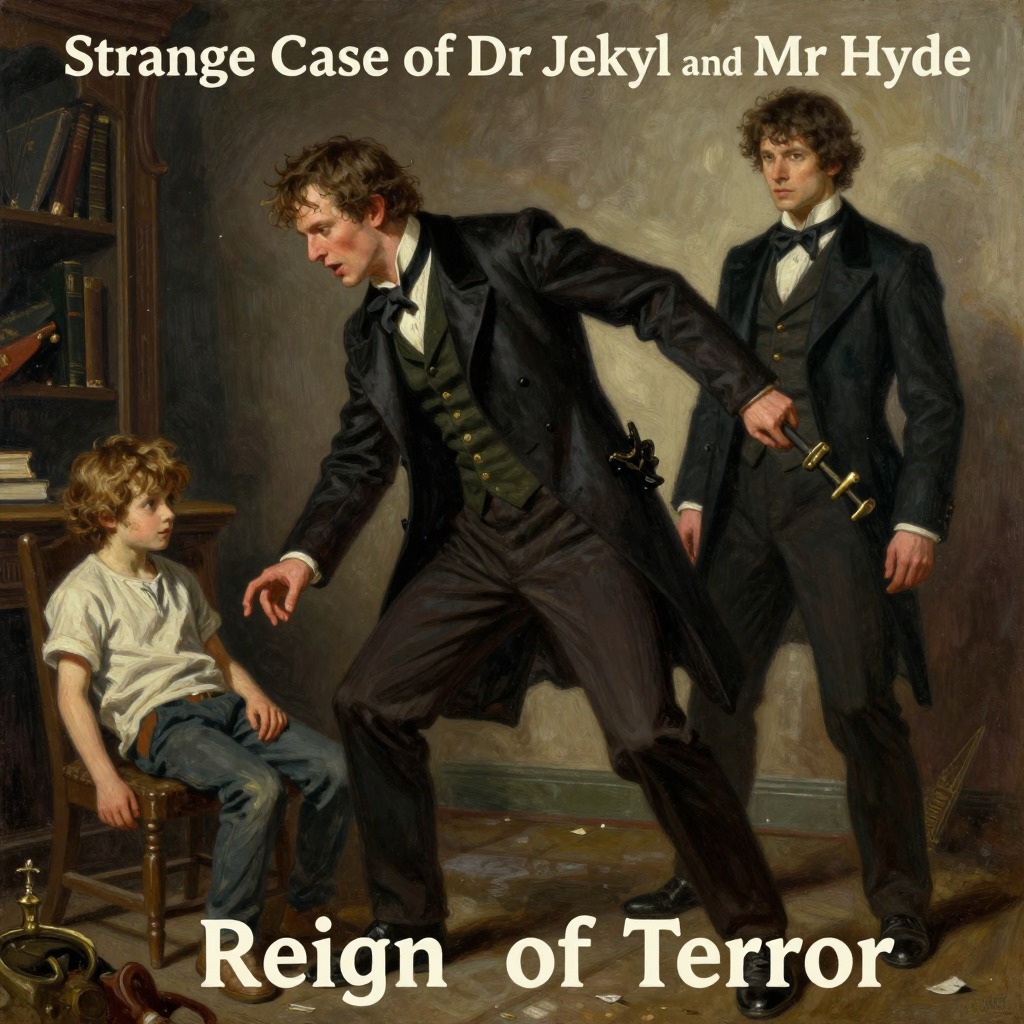
Hyde's first known act of cruelty is the trampling of a young girl in the street at three o'clock on a black winter morning, an event witnessed by Enfield. He is described as trampling "calmly over the child's body and left her screaming on the ground," an act that Enfield likens to a "damned Juggernaut." To avoid a scandal, Hyde pays the family one hundred pounds, using a cheque signed by Henry Jekyll. This incident introduces him to the reader and to Utterson, who becomes obsessed with uncovering the connection between his respected friend and this detestable figure. Nearly a year later, Hyde commits the far more serious crime of murdering Sir Danvers Carew, an aged and beautiful gentleman. The murder is witnessed by a maid, who sees Hyde, after a brief and polite exchange, break out in a "great flame of anger," club the old man to the earth with a heavy cane, and then, with "ape-like fury," trample his victim underfoot, shattering his bones. After the murder, Hyde disappears, having fled the scene and destroyed his papers. He is eventually tracked down by Utterson and Inspector Newcomen to his house in Soho, a dingy and disreputable quarter, but he has already vanished. For a time, he is "blotted out" from the knowledge of the police, and Jekyll seems to enjoy a period of peace. However, Hyde's power over Jekyll grows, and he begins to emerge involuntarily, first in Jekyll's bed, then in Regent's Park, and finally with increasing frequency, forcing Jekyll to rely on the transformative drug to maintain his own identity. The struggle culminates in Hyde's final, desperate act: he locks himself in Jekyll's cabinet, and when Poole and Utterson break down the door, they find him dead on the floor, having swallowed a crushed phial of poison. The body is "sorely contorted and still twitching," dressed in clothes far too large for him, the clothes of Dr. Jekyll.
Key Actions and Objectives
Hyde's primary objective is the unfettered gratification of his own evil desires. Jekyll describes him as "a being inherently malign and villainous; his every act and thought centered on self; drinking pleasure with bestial avidity from any degree of torture to another." His actions are driven by a pure, unthinking malice. The trampling of the child is described as a casual, almost absent-minded act of cruelty. The murder of Sir Danvers Carew is a sudden, explosive eruption of violence, carried out with "ape-like fury" and a "transport of glee." After the murder, Hyde is described as "glorying and trembling, my lust of evil gratified and stimulated." He also demonstrates a cunning self-preservation instinct. He secures a separate house in Soho, opens a bank account in his own name, and forges Jekyll's signature to create a separate identity. After the murder, he composes letters to Lanyon and Poole to secure the drugs he needs to transform back into Jekyll, and he is described as "astute" in mastering his fury to do so. His final act, suicide, is a desperate attempt to destroy Jekyll along with himself, a final expression of the hatred he feels for his other self.
Relationships and Conflict
Hyde's central relationship is with Henry Jekyll, from whom he is born and to whom he is inextricably bound. Jekyll describes their connection as a "co-heirship to death," with Hyde being "knit to him closer than a wife, closer than an eye." The relationship is one of profound conflict. Jekyll feels a horror of Hyde, seeing him as "something not only hellish but inorganic." Hyde, in turn, resents Jekyll and plays "ape-like tricks" on him, such as scrawling blasphemies in Jekyll's books and destroying his father's portrait. Yet, Jekyll also notes a "wonderful" love from Hyde, a desperate attachment born of Hyde's fear that Jekyll will cut him off by suicide. With everyone else, Hyde inspires only fear and hatred. Enfield, the child's family, and even the doctor all feel a desire to kill him. Utterson feels a "nausea and distaste of life" after meeting him. The maid who witnesses the murder had already conceived a dislike for him. His housekeeper in Soho, an "ivory-faced and silvery-haired old woman" with an "evil face," shows a "flash of odious joy" when she learns he is in trouble, indicating he is not a popular character even among his own associates. The only person who shows him any concern is Jekyll, who asks Utterson to promise to help Hyde after his own death, a request that baffles and disturbs the lawyer.
Change and Ending
Hyde undergoes a significant change over the course of the story, growing in power and stature as Jekyll's hold on his own identity weakens. Jekyll notes that "the body of Edward Hyde had grown in stature" and that the balance of his nature was being "permanently overthrown." The involuntary transformations, where Jekyll wakes up as Hyde, demonstrate that Hyde is no longer a creature Jekyll can summon and dismiss at will but an independent force that is taking over. His final change is his death. Cornered and unable to return to Jekyll's form because the original salt has run out, Hyde chooses suicide. He is found dead in the cabinet, having swallowed poison. Utterson declares, "Hyde is gone to his account," and the body is left lying on the carpet, a final, grotesque testament to the evil that had been unleashed.
Narrative Role and Evaluation
Edward Hyde functions as the novel's central symbol of the repressed, evil side of human nature. He is the "shadow" archetype, the embodiment of everything that the respectable Dr. Jekyll cannot acknowledge in himself. His very name, "Hyde," suggests something hidden, while his physical form is a direct expression of his moral deformity. He is a flat character in E. M. Forster's terms, built around a single idea—pure evil—and he is instantly recognizable by the universal revulsion he inspires. His role is to create the central mystery of the plot and to force the reader to confront the uncomfortable truth that evil is not an external force but a part of the self. His actions, particularly the murder of Sir Danvers Carew, serve as the catalyst for the story's climax, driving Jekyll to his final, desperate confession. Hyde's ultimate fate—suicide—is a recognition that such a pure, unalloyed evil cannot coexist with the rest of humanity and must destroy itself.